Technological innovation and human responsibility
Ein Erfahrungsbericht und ein Blick nach vorn
Im vergangenen Jahr haben wir gemeinsam mit der KJSH Kinder Jugend und Soziale Hilfen zwei innovative Prototypen entwickelt und getestet. Ziel war es, den Einsatz von Künstlicher Intelligenz und Virtueller Realität in der Kinder und Jugendhilfe praxisnah zu erkunden und erste belastbare Erfahrungen zu sammeln.
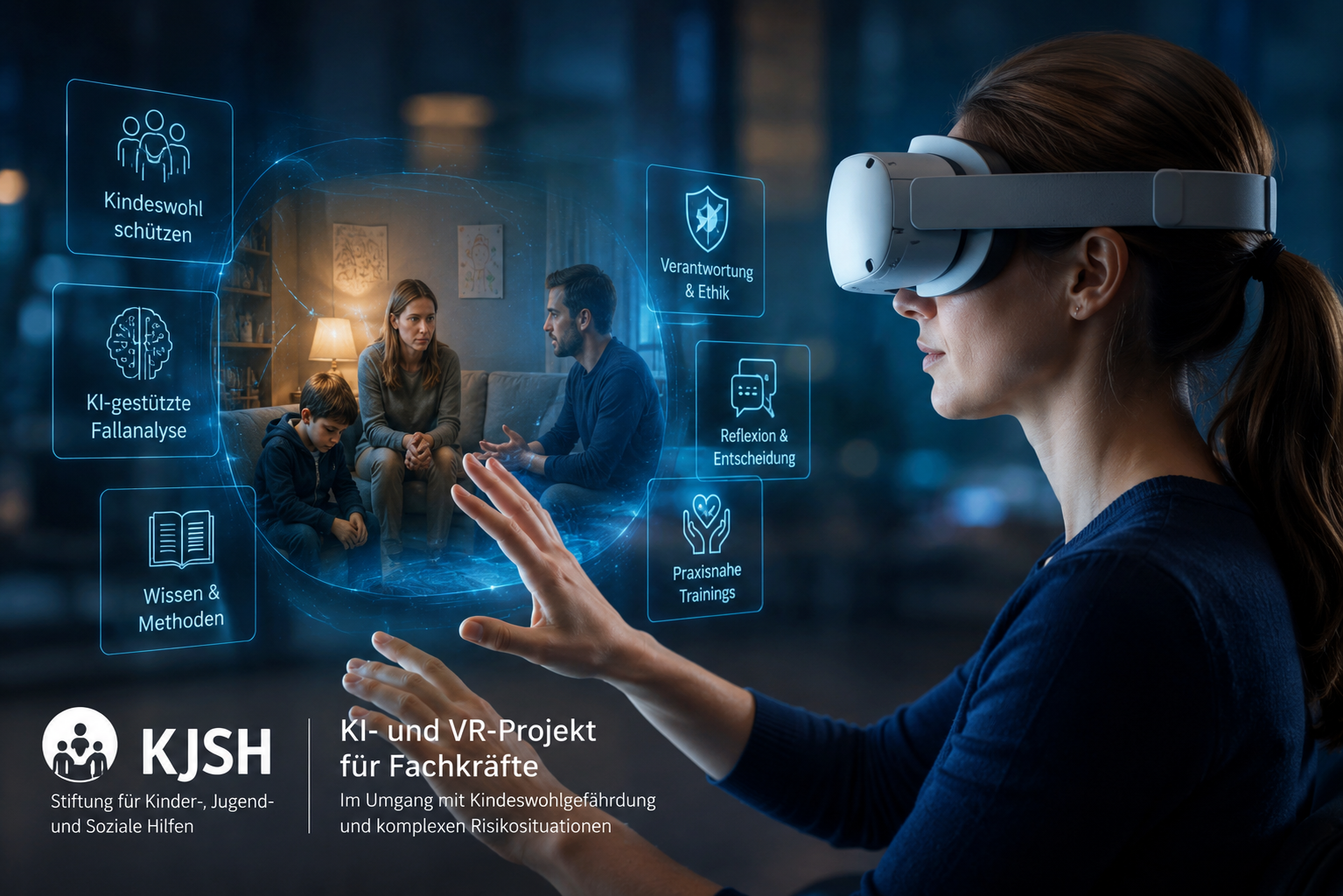
In the first step, an AI prototype was developed to support professionals in assessing risks to children’s well-being and vulnerability. The application is based on anonymized case descriptions, relevant professional guidelines and relevant specialist literature. The prototype generates structured and comprehensible assessments and is designed to independently identify and request missing information in the future.
In addition, a VR prototype was developed that depicts a virtual home. In this photorealistic environment, professionals can train risk characteristics in a safe and controlled manner in the home environment. The scenarios and risk constellations are generated interactively by the AI. In particular, this strengthens observation skills, professional reflection and confidence in assessing complex situations.
Both systems pursue the goal of sustainably strengthening reflection, decision-making reliability and professional quality. The insights gained form the basis for a pilot project in the year two thousand and twenty-six, in which a practical system is to be developed for broader use within the organization.
Insights beyond the technical implementation
The work on these prototypes was more than just a technical development project. In the joint process with specialists, teams and management levels, not only were systems tested, but fundamental questions became visible. Questions about responsibility, decision-making logic, trust and the role of people in an increasingly technological practice.
The close connection between technical development, professional reflection and accompanying communication has made it clear that the actual findings extend far beyond the concrete application of AI and VR. The practical work resulted in a deeper understanding of the inner attitudes, skills and forms of leadership required to shape technological innovation responsibly.
The following reflections on people in technological change are therefore not a theoretical treatise. They are the result of concrete experience, joint learning processes and a conscious examination of the opportunities and limitations of new technologies in practice.
The human being in technological change
Why inner integrity, awareness and responsibility are becoming key skills of the future
We are living in a phase of rapid technological acceleration. Artificial intelligence, immersive spaces and data-driven systems are no longer just tools, but are actively helping to shape reality. Decisions are becoming faster, more complex and increasingly follow machine logic. This makes a fundamental question of all progress all the more pressing: how do people remain whole?
Technology is not only changing processes and business models, but also self-images, relationships and social structures. Managers and designers therefore bear a new form of responsibility. It is no longer enough to understand technical possibilities. The ability to recognize what remains humanly necessary is crucial. Future viability arises where technological development is combined with inner clarity, an ethical attitude and cultural awareness.
The focus here is on preserving inner integrity. In a world of constant stimuli, algorithmic recommendations and virtual identities, conscious self-control becomes a crucial resource. Those who make decisions without being connected to their own inner truth relinquish creative power to external systems. Those who act out of presence and clarity, on the other hand, can use technology as an extension of human effectiveness.
Four core topics form the orientation framework for a responsible technological future.
Firstly: Responsible Technology.
Technology only has a future if it protects people. Artificial intelligence and metaverse must be designed in such a way that they strengthen identity, autonomy and social responsibility. It’s about data protection, legally secure spaces, digital sovereignty and systems that empower rather than manipulate. Responsibility does not begin with use, but with design.
Second: Human Centered Leadership and Awareness.
Technological change rarely fails because of technology, but because of the internal dynamics of organizations. Emotions, relationships, fears and power structures determine whether new systems are integrated in a meaningful way. Leadership in the age of AI means being aware of these dynamics and embodying responsibility rather than relinquishing it. Leadership succeeds where inner clarity meets technical understanding.
Thirdly: Future Culture and Human Identity.
Technology is never neutral. It creates narratives, shapes self-images and influences how we think about the future. Immersive spaces and digital identities change our perception of our own place in society. The cultural future is created at the interface of technology, narrative and identity. This is where it is decided whether people remain creators or become objects of technical systems.
Fourthly: Inner Integrity.
In a world in which systems move processes, the ability to shape them is reserved for those who are anchored in their inner truth. Conscious presence becomes the basis for responsible decisions. Inner integrity is no longer a private quality, but a social competence. It is the most stable reference in a constantly changing digital environment.
This perspective combines central concerns such as the protection of identities, intellectual self-control, data sovereignty, sustainability, European sovereignty, digital ownership models, decentralization and democratic design. It locates the human being as Human 1.0 in the context of Web 4.0 and makes it clear that technological progress will come to nothing without human maturation.
The key question for the future is therefore not what technology can do, but who we need to be in order to shape it responsibly. A human future is created where technological innovation meets inner clarity, an ethical attitude and cultural responsibility.
Key learnings
- Technological progress is not sustainable without inner development. The faster systems become, the more important human awareness becomes as a balancing force.
- Responsibility begins with the design of technology. Artificial intelligence and metaverse shape behavior, identity and society. Their design determines freedom or dependency.
- Leadership in the digital age is an internal task. Emotional and psychological dynamics determine the success of technological transformation more than technical excellence.
- Identity is becoming a key resource. In immersive and data-driven environments, identity must remain protected, consciously shaped and self-determined.
- Inner integrity is a future competence. Those who are not connected to their own inner truth lose creative power to systems and external logics.
- Technology needs cultural embedding. Narratives determine whether new technologies are perceived as a threat or as an opportunity for human development.
- Sovereignty is more than just technology. Data sovereignty, digital property rights and European values are an expression of a conscious social self-image.
- People remain the benchmark. Technology serves people or it fails to achieve its purpose. This decision is made anew every day.